Written
AI: A New Kind of ‘Entropy Reduction’
From steam engines to large language models, explore how four industrial revolutions countered entropy increase—and how AI could become the core engine of next-generation civilisation by autonomously generating rules.
Languages:中文
“IT FEEDS ON ‘NEGATIVE ENTROPY’.”
— Erwin Schrödinger, What Is Life? (1944), Chapter 6
Over the long evolution of the universe, differences are smoothed out, structures break down, and energy gradually dissipates. Stars will eventually go dark; temperature gradients will flatten; any delicate structure without continual energy and maintenance will loosen and decay. The second law of thermodynamics reminds us that, in an isolated system without external input, total entropy does not decrease spontaneously; local entropy reduction is always accompanied by a larger increase elsewhere.
Life is a miracle in precisely this sense. Earth, billions of years ago, was not an isolated system: it received high-quality energy from the Sun and radiated a larger amount of low-temperature heat into space. Along this energy flow, chemical reactions involving carbon, hydrogen, oxygen, nitrogen, and other elements gradually formed boundaries, metabolism, replication, and evolution. The cell membrane separated inside from outside. By exporting more entropy to its environment, life maintained an extraordinarily complex and fragile local order.
Life is not a counterexample to the second law. It is one of the law’s most magnificent permitted forms of local entropy reduction: it builds structure at the cost of external energy, and persists at the cost of greater entropy increase in its surroundings.
Human civilisation can be seen as an extension of this current against disorder. Life maintains cellular order through metabolism; civilisation keeps inventing new cycles that organise energy, matter, and information, maintaining, reproducing, and extending local order at a larger scale.
The first three modern industrial revolutions were three leaps in this capacity. Has the fourth industrial revolution arrived? And how might this new kind of “entropy reduction” work?
Not Eliminating Entropy, but Automating Local Order
Here, “entropy reduction” means local order in an engineering and control sense: under a defined goal, making formerly uncertain and difficult-to-coordinate processes more stable, more predictable, and more actionable. The labels “energy entropy reduction” and “energy-system entropy reduction” below are metaphors for changing objects of control, not new thermodynamic quantities.
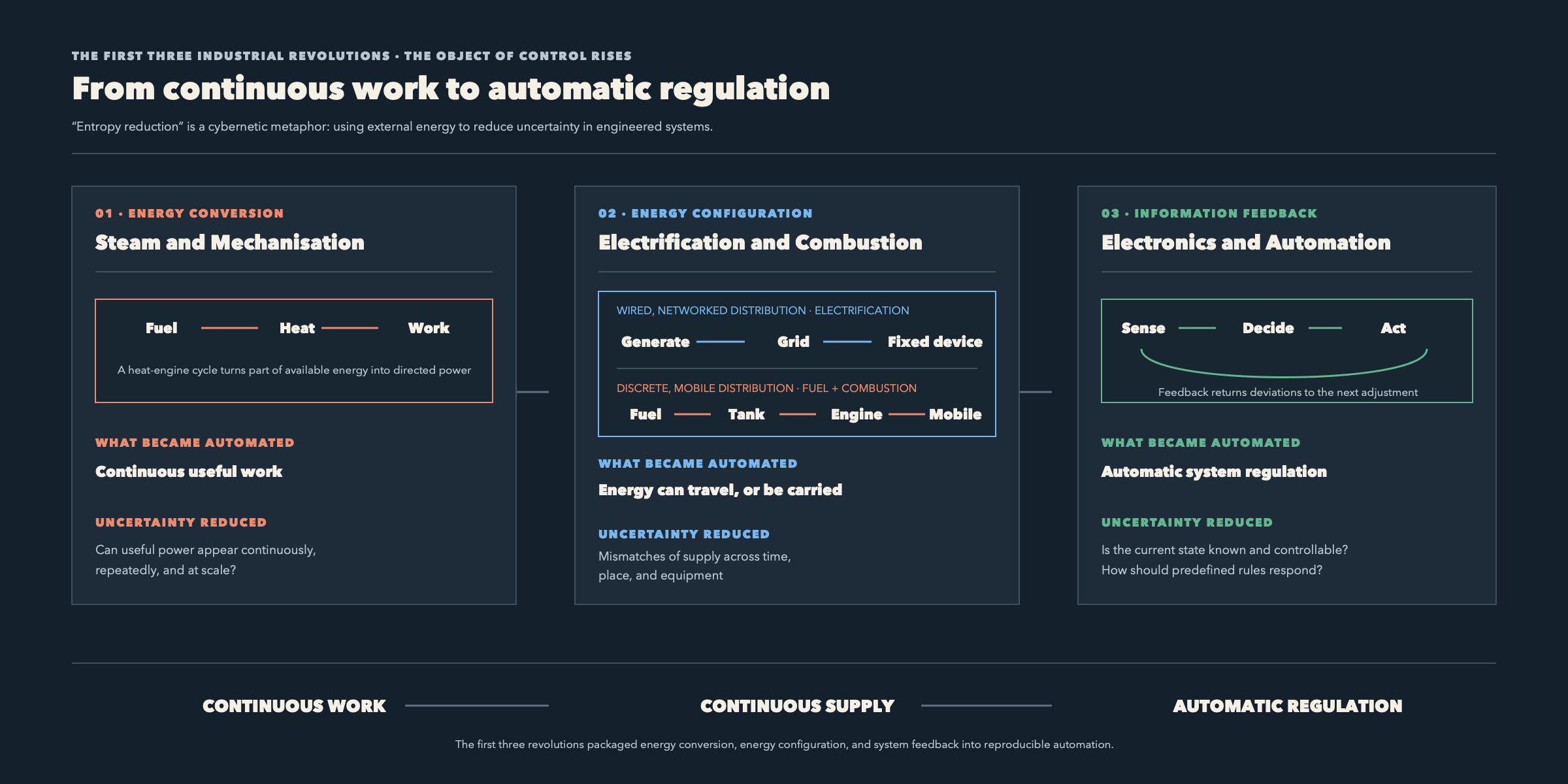
The first three industrial revolutions can therefore be read as a sequence in which the object of control rises:
- First, controlling how energy does work: reducing uncertainty in energy conversion.
- Then, controlling how energy is stored, delivered, and distributed: reducing uncertainty in energy configuration.
- Then, controlling how complex systems respond to a policy: reducing uncertainty in state and coordination.
The First Industrial Revolution: Controlling How Energy Performs Continuous Work
Before the industrial revolution, people did not lack sources of power. Humans and animals could exert force; windmills and waterwheels could turn. Yet all were constrained by bodies, weather, rivers, and place. Their power, duration, and reproducibility were difficult to organise for use on demand.
The steam engine changed not whether energy existed, but whether energy stored in fuel could perform stable work here and now. Coal produced heat; boilers turned water into high-pressure steam; cylinders, pistons, and cranks converted part of that steam pressure into directed reciprocating and rotary motion. So long as fuel, water, and maintenance continued, the process could repeat. People no longer had to depend on whether a particular horse was tired, or wait for a gust of wind or a suitable stretch of river.
This was a continuous, automated conversion of energy. A heat engine did not stop heat from dissipating, nor did it violate the second law. Amid overall entropy increase, it extracted part of the mechanical work available from a temperature difference and packaged it as repeatable power.
This revolution replaced primitive biological power and unstable natural power with stable power.
Energy entropy reduction: The first industrial revolution controlled the conversion of energy, reducing uncertainty about whether useful power could appear continuously, repeatedly, and at scale. Mechanical structure extracted useful work from a temperature difference and formed stable local power.
The Second Industrial Revolution: Controlling Energy Across Time and Space
The steam engine gave humanity stable power, but not genuine freedom in distributing it through space. Inside the factory, power remained anchored around a prime mover, driving an entire workshop through elaborate shafts and belts. It was hard to transmit far or divide finely. Outside the factory, steam locomotives took power into open country, but carried bulky coal and water and remained tied to pre-laid rails. Energy was still deeply bound to heavy mechanical objects and rigid infrastructure.
The second industrial revolution fundamentally reorganised how energy was organised, greatly increasing the decoupling and schedulability of energy production, storage, and use. Two complementary routes improved energy distribution across wide areas and long spans of time:
-
The first route was wired, networked distribution: electrification.
It separated power production from use in space. Power stations produced electricity centrally; grids transmitted it over distance; and motors at the edge delivered power to each individual device as needed. Grids still face transmission losses, capacity limits, and the requirement to balance supply and demand almost in real time. Yet they did move the logic of starting, regulating, and converting power from a factory’s common line shaft to independent endpoints at each machine.
-
The second route was discrete distribution without a wire: oil and the internal-combustion engine.
If grids solved long-distance power for fixed equipment, internal-combustion engines freed mobile equipment from direct dependence on rails and wires. Oil offered a high-energy-density chemical reserve that could be standardised, packaged, and transported; the engine shrank what had been a large power installation into an energy-conversion terminal carried with the machine. Pipelines, tankers, and filling stations formed a logistics network that allowed cars, ships, and farm machinery to draw on this packaged energy on demand.
The grid let energy flow through networks across space; the fuel tank and internal-combustion engine let it travel with equipment, freed from wires and rails.
This revolution replaced fixed forms of energy organisation with an unprecedentedly flexible capacity to configure energy.
Energy-system entropy reduction: The second industrial revolution controlled energy’s configuration through time and space, reducing mismatches among its production, storage, transport, distribution, and use. Grid coordination and packaged fuel significantly eased the temporal and spatial obstacles between energy supply and demand.
The Third Industrial Revolution: Making Complex Systems Respond to Policy
Once equipment, factories, and supply chains became sufficiently complex, continuous and widely distributed power was no longer enough. A system also had to know its own state: was a machine tool misaligned, was a temperature drifting? How could vast accounts be reconciled, market demand communicated, and teams across regions coordinated? In physical production and in human organisation alike, control speed and precision become bottlenecks when systems rely only on human observation, paper workflows, and mechanical linkages.
Sensors, communications networks, computers, and software reshaped machines and human society together. They turned physical processes and organisational behaviour into readable data, and control experience into executable programs. On the shop floor, CNC machines and automated production lines formed faster physical loops of “sense — decide — act — feed back.” In firms and society, databases and the internet greatly reduced the cost of passing information and coordinating across organisations and geography, allowing finance, logistics, and people to be coordinated over shorter feedback cycles. When a deviation appears, a controller or program can adjust according to predefined rules.
In information-theoretic terms, this reduces the controller’s conditional uncertainty about the system state. With data and control models, a system no longer has to wait passively for a machine failure or an organisational crisis to become visible. It can identify deviations earlier and coordinate innumerable parts. Information is not free: sensing, communication, and computation also consume energy. But smaller, more structured signals can direct immense flows of energy, matter, and human cooperation.
This revolution replaced rigid mechanical linkage and slow human communication with more flexible, precise feedback regulation of complex systems.
Information entropy reduction: The third industrial revolution controlled the state-and-policy loop of complex systems, reducing uncertainty about “what is happening now in machines and human organisations, and how should predefined rules respond?”
What Entropy Does the Fourth Industrial Revolution Reduce?
If the third industrial revolution greatly reduced uncertainty in physical and organisational systems through computers and the internet, what “entropy” remains to be reduced today?
The answer lies in a side effect of the third revolution.
By digitising more of the world, it created an immense ocean of data. Autonomous-driving sensors generate vast point clouds every second; genome sequencers output billions of base pairs; the internet produces an endless stream of text each day. This raw data is massive and high-dimensional, with noise and redundancy intertwined. For a specific task, it has not yet been compressed into a representation that supports direct action, and so it creates great cognitive and decision uncertainty.
In this data explosion, the explicit-rule control paradigm of the third industrial revolution starts to have insufficient coverage in open, high-dimensional, long-tail settings. Its typical logic is: humans understand the world and write determinate rules (code / if-else); machines execute them quickly.
But real-world variation grows exponentially. Across millions of unexpected road situations, the subtle semantics of natural language, or the countless possible protein folds, human cognitive bandwidth and programming capacity reach their limits: we cannot exhaustively write every rule.
Faced with chaotic data, what should the right response rule be?
At this point, the system’s largest “entropy” is no longer a lack of information but cognitive paralysis caused by information overload. We might call it cognitive entropy.
To keep evolving, civilisation needs a new mechanism to help people confront complex raw data and extract patterns that can guide action, thereby reducing uncertainty about rules and strategies. This is where the picture of the next industrial revolution begins to come into focus.
The Autonomous Generation of Control Strategies and Knowledge: A Next Industrial Revolution?
When the rate of writing rules falls far behind the rate at which a system changes, complex systems maintained through human pre-specified logic again become prone to failure and loss of control.
AI, especially deep learning and large language models, moves control capability upward. It no longer only executes rules that humans have exhaustively written; under given data, goals, and constraints, it can learn task-relevant representations and propose candidate rules, plans, and instructions. From AlphaFold’s protein-structure predictions to generative AI that produces code and text, machines are taking on part of the work of finding patterns in complex data and forming candidate knowledge and strategies.
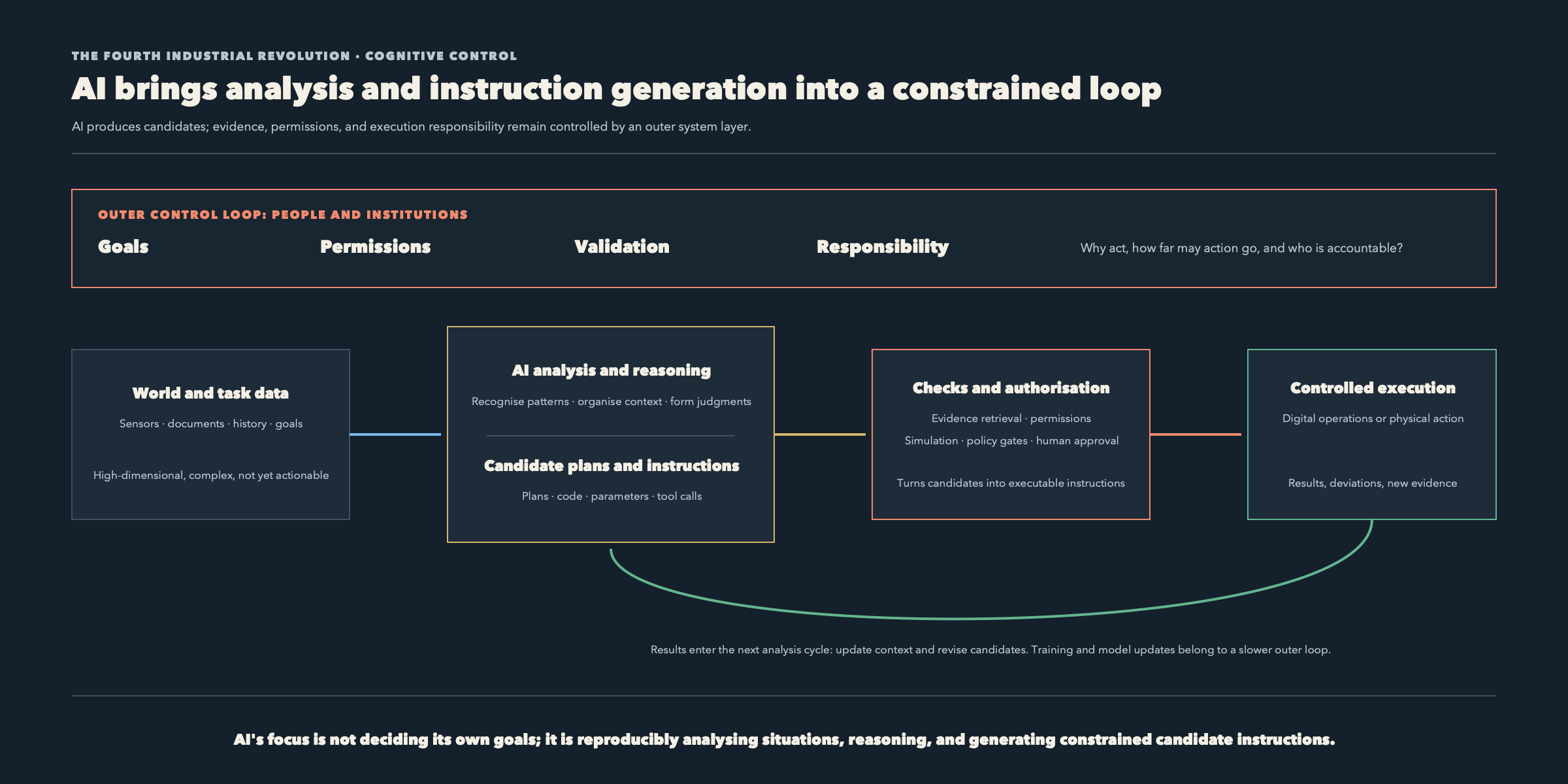
From an information-theoretic and cybernetic perspective, this is no longer just the transmission or processing of predetermined information. The system consumes computation to compress complex data into task-relevant representations and generate candidate knowledge and strategies that can be tested. This does not mean handing ultimate control to algorithms: people and institutions must still define goals, provide evidence, impose constraints, and bear responsibility for model outputs.
AI’s central value is not that it mysteriously “learns itself” at every step, but that it can analyse and denoise high-dimensional information at runtime. It can receive a complicated situation, recognise patterns, analyse and reason, then generate candidate answers, plans, code parameters, or tool instructions. It turns some forms of human mental labour once deeply tied to individual people — induction, decomposition, expression, and proposal generation — into computation that can be copied, run in parallel, and does not tire.
If this revolution succeeds, what is partly replaced is the single mode of control built on human-written static rules and limited cognitive bandwidth. Humanity gains an automated intellectual engine for generating and evaluating knowledge and strategies from complex situations.
Cognitive / intellectual entropy reduction: The next industrial revolution controls the process through which rules and order are generated. It reduces uncertainty about how a system, faced with unknown and extremely complex situations, can generate candidate strategies that can be evaluated and improved under feedback and constraints. By processing complex data at scale, AI forms task-relevant representations and strategies, shifting from “respond with predefined rules” to “generate candidate rules within constraints.”
The Next Industrial Revolution’s Difficulty, and Human Value
The difficulty of this revolution is converting AI-generated candidate instructions into real actions safely, controllably, and reliably. AI becomes part of an industrial or social control system only when those candidates enter a constrained execution path.
The strength of AI itself, such as model capability, is only one element of an inner system loop. A system needs to retrieve evidence, check permissions, run simulations or rule checks, execute an operation, and return the result to the next round of analysis. That makes a faster inner loop. Model training, evaluation, and updating form a slower outer loop. Under continuous evaluation, version control, and safety constraints, these processes can improve some capabilities, but they do not guarantee continuous or universal improvement, nor should they replace human authority over goals, risk boundaries, and ultimate responsibility.
In this new human-machine control loop, how should people change organisational forms to adapt to a new control paradigm, and how can they ensure stability and safety? These are central questions in whether a next industrial revolution can truly take shape.
Every industrial revolution’s “entropy reduction” has required changes in human organisation. Society has inertia, and every transformation breaks an inherited structure. That is also a force in social evolution: people must redefine their roles, redesign workflows, and reorganise social structures to fit a new control paradigm.
The purpose of all this technical, engineering, and organisational evolution remains to preserve the floor of human values and responsibility while giving machines part of the work of addressing complex variation. Human minds can be released from some repetitive daily work to focus more on higher-value work and ideals.
The Current Against Entropy Is Modern Civilisation’s Progress — and an Expansion of Human Value
Steam engines automated work; grids and internal-combustion engines automated energy supply; computers automated feedback regulation; AI begins to automate the part of mental operation that analyses situations and generates instructions.
These four sweeping revolutions in productive capacity are, in essence, a centuries-long upward movement in what humanity can control:
- Energy entropy reduction: humanity controlled physical work, reducing dependence on natural power and muscle to gain stable power.
- Energy-system entropy reduction: humanity controlled configuration across time and space, moving beyond the limits of a single shaft, rail, or wire to gain a more flexible network.
- Information entropy reduction: humanity controlled system response, reducing dependence on rigid mechanical linkage and slow information flow to gain faster coordination.
- Cognitive entropy reduction: humanity began to control rule generation, supplementing the limits of static code and finite mental bandwidth with evaluable candidate strategies.
Together, these do not form an escape from the universe’s overall movement toward entropy increase. They form the magnificent history of humanity, as a macroscopic living system, continually raising its capacity to maintain local order.
Giving machines part of execution and inference does not mean that people leave the system. It requires human value to be realised in new ways.
When we hand over heavy physical labour, tedious scheduling, immense calculation, and even some inductive and generative mental labour to machines, we may reduce the repetitive burden of maintaining complex systems. Yet people must still supervise, hold systems accountable, correct errors, and negotiate goals.
Humanity must return to the system’s outer control loop: continually defining civilisation’s goals, ethical boundaries, and allocation of responsibility.
Against the vast background of entropy increase, machines can help us understand and respond to complexity. But people must continually decide what goals the system serves, what boundaries it observes, and who bears the consequences.
Human value in the age of AI is not to be “replaced,” but to be “augmented.”
Discussion